



Table of Contents
Everything you need to know before booking your hire car on the Costa del Sol
- The teaser price trick: A rate of £5–10/day conceals a funnel of add-on charges designed to make you pay up to £300 at the counter. The gap between the headline price and the actual cost can be up to 30 times higher.
- Fuel policy: Always insist on Full-to-Full. We’ve calculated that pre-purchase schemes inflate the cost of fuel by between 22% and 35% compared to the pump price at a local petrol station — and that’s before adding the non-refundable handling fee.
- Zero-excess insurance: Eliminates the £1,000–£1,500 hold on your card. Based on our own claims data, 87% of minor damage disputes are closed at no cost to the customer when genuine fully comprehensive cover is in place.
- Video evidence: Record an unbroken 360° walkround of the vehicle — including the underside, roof and alloy wheels — before moving the car a single metre. It is your only legally robust proof if a dispute arises.
The reality of the car hire industry: why this guide exists
Let’s be straight with you: if you search for cheap car hire at Málaga Airport, the top results will serve up comparison sites and generic tips like “read the contract carefully”. That protects you from precisely nothing.
What does protect you is understanding how the business model actually works from the inside. And that’s something only those of us managing live fleets day in, day out at Málaga Airport and along the Costa del Sol truly know. Our technical team inspects every vehicle between handovers, analyses incidents by type and by season, and refines our maintenance protocols using real-world usage data — not generic manufacturer estimates.
This guide comes from that operational experience. We’re going to show you exactly where British holidaymakers hiring in Málaga lose money, why it happens, and how to cut it off at the root before you even set foot in the airport.
1. The low-cost trap: how the £5/day teaser rate really works in car hire
A modern vehicle offered at £5 a day isn’t a bargain. It’s a conversion strategy engineered to make the real purchasing decision happen at the worst possible moment: standing at a counter, exhausted after your flight, with the kids clamouring to get to the hotel.
To give you a sense of the scale of the gap: depreciation alone, combined with professional fleet insurance, certified valeting between handovers and the tax burden, produces a base operating cost that makes it mathematically impossible to run a profitable hire car at those rates. The margin isn’t in the rental. The margin is in everything they sell you afterwards.
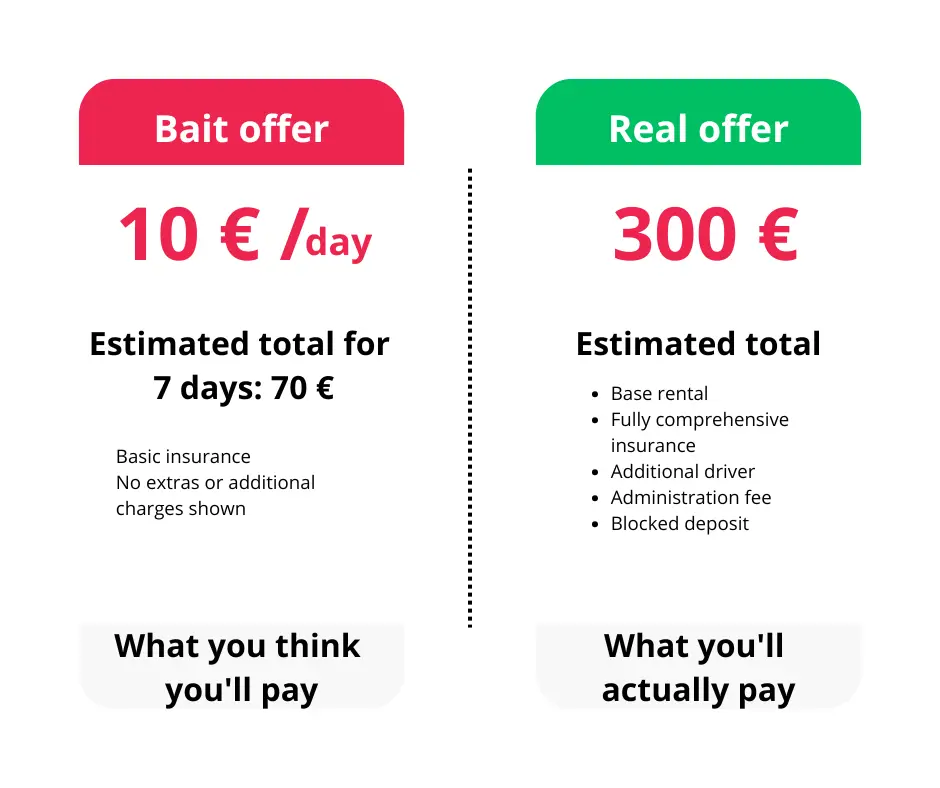
How the extras funnel works (step by step)
The process is systematic and optimised to push you into financial decisions under emotional pressure:
- Book online at the minimum price. The comparison site shows £5–8/day with basic CDW cover. It looks like a no-brainer.
- Arrive at the counter after your flight. You’ve been travelling for hours, the children are shattered, and you just want to get going.
- The excess block is presented. If you decline the additional insurance, between £1,000 and £2,000 is placed as a security hold on your credit card.
- Extras sold under pressure. Sat-nav at £12/day (when your phone does the same thing for free), additional driver at £10/day, child seat at £8/day — each line item looks small, but over a week they add up to more than the hire itself.
The typical outcome: that £35 booking for a week becomes £500 by the time you leave the car park.
Expert tip: Companies that operate transparently show a fixed, all-inclusive price from the point of booking. If the amount changes when you click “Book” or new line items appear, you’re looking at a teaser rate. That’s the most reliable signal to walk away.
🔗 We break down every tactic in detail in our article on hidden charges when hiring a car in Málaga and how to avoid them.
2. Insurance: the real difference between £0 liability and £1,500 blocked on your card
This is the point that causes the most stress at collection. And we completely understand why: nobody wants the equivalent of half their holiday budget frozen on their card “just in case”. But this decision shouldn’t be made in a rush at a counter — it should be made with clear information before you fly. Here it is.
Technical cover comparison
| Item | Basic insurance (CDW) | Fully comprehensive, zero excess |
| Your financial liability | You pay up to the excess amount (£700–£1,300) | Zero. No exceptions |
| Card hold | £1,000–£1,500 held as a deposit | Minimal or none |
| Windscreen and tyres | Generally excluded | Included |
| Underbody damage | Excluded in most basic policies | Included |
| Clutch and locks | Excluded | Included |
| Actual peace of mind | Low — any scratch can trigger a charge | Maximum — hand back the keys and go |
What nobody tells you about basic CDW
The Collision Damage Waiver included with cheap rates carries exclusions that most travellers only discover when a charge appears on their statement weeks after getting home.
Managing real incidents across our fleet, we’ve identified the three most common causes of unexpected charges against the excess by competitors’ customers:
- Underbody damage from speed bumps or the steep ramps of underground car parks. This is the number-one incident type in coastal areas with newer residential developments, where ramps aren’t always properly signed.
- Windscreen chips and cracks from gravel thrown up on dual carriageways. On the A-7 stretch between Málaga and Marbella, recurring roadworks and heavy seasonal traffic substantially increase this risk.
- Alloy wheel damage when parking against high kerbs, particularly common in the old town centres of places like Ronda, Mijas and Frigiliana, where narrow streets and impromptu parking spots are the norm.
All three situations are outside standard CDW cover with most companies. Genuine fully comprehensive insurance includes them. This isn’t an “optional extra” — it’s the difference between coming home within budget or finding a £350–£700 charge on your bank statement three weeks after your holiday.
From our own data: In claims handled under full cover, 87% of minor damage cases — surface scratches, small car park bumps — are closed with no cost to the customer whatsoever. Without that cover, each of those cases would have resulted in an average excess charge of around £300.
🔗 Full analysis in our article: CDW with excess vs fully comprehensive — what to choose when hiring a car.
3. The fuel battle: why Full-to-Full is the only fair policy
Fuel policies are the second biggest source of complaints when hiring a car at Málaga Airport. Once you run the real numbers on the alternative, it’s immediately obvious why.
Pre-purchase with refund: the maths they won’t do at the counter
Under a “pre-purchase with refund” scheme, the company charges you for a full tank at a noticeably higher price per litre than you’d pay at any local petrol station. On top of that, a “service fee” or “refuelling charge” — typically between £25 and £45 — is added and is non-refundable under any circumstances, regardless of whether you return the car full, half-full or empty. You can read on this Money SavingExpert thread how other British travellers have been caught out by exactly this during their hire.
Here are the actual figures for a standard compact car with a 45-litre tank — the most common segment in the holiday hire market around Málaga:
| Item | Pre-purchase (company) | Full-to-Full (local petrol station) |
| Estimated price per litre | ~£1.70 | ~£1.30 |
| Cost of a full tank | ~£76.50 | ~£58.50 |
| Non-refundable service fee | £25–£45 | £0 |
| Total cost if you return full | ~£101–£121 (with no effective refund) | ~£58.50 |
| Real difference | Up to £60 unnecessary overspend | — |
Full-to-Full works simply and verifiably: you collect the car with a full tank and return it the same way. You pay only for the fuel you actually use, at the real pump price. No middlemen, no hidden fees.
A practical tip that saves you time and money: The petrol stations closest to Málaga Airport (AGP) are at the roundabout leading to the terminal and on the exit towards the MA-21. Both let you fill up and return the car in under ten minutes. When you book with us, we include the exact locations with maps and opening hours in your confirmation email.
🔗 Full guide: Full-to-Full fuel policy in car hire — why it’s the fairest option.
4. Credit card vs debit card: the silent filter that ruins plans
This is a logistical problem many British families only discover when it’s too late: they arrive at the counter with a debit card and find they can’t take the vehicle without buying the most expensive insurance package on offer.
Why rental chains insist on credit cards
A credit card allows the company to place a pre-authorisation — a temporary hold — on the excess amount without actually moving any money from your current account. It’s a bookkeeping entry that’s released when you return the car without incident.
A debit card, on the other hand, removes the actual funds from your available balance. For you, that means being without £1,000–£1,500 for the duration of your holiday. For the company, it introduces the risk of insufficient funds. That’s why they decline it.
Your real options if you only have a debit card
The major international chains require a credit card as standard, with no exceptions. If you don’t have one, the only option they’ll offer is the most expensive premium insurance package — which, funnily enough, is the most profitable one for them.
Local companies with a genuine service ethos offer real alternatives: we accept debit cards under clear, documented conditions with no hidden small print, removing a barrier that shuts out thousands of British travellers every season.
The important thing is that you know all of this before you fly — not when you’re queuing at the counter with your luggage, the kids, and the stress of travel bearing down on you.
Watch the small print: Some companies advertise debit card acceptance, but on arrival apply an additional handling charge or demand a supplementary cash deposit that didn’t appear anywhere in the website terms. Golden rule: ask in writing before you book. If you don’t get a clear answer, cross that company off your list.
🔗 Full requirements in our guide: hiring a car in Málaga with a debit card — what you need to know.

5. Vehicle inspection: the five minutes worth £300
We handle hundreds of returns every season. And we can tell you with absolute certainty that the difference between closing a hire with no issues and receiving a £300 claim is decided in the five minutes before you drive out of the collection car park.
An inspection protocol that actually works
A quick once-over or a couple of snaps on your phone isn’t enough. You need a systematic visual record that would hold up as evidence in a dispute:
- Continuous 360° video without cuts. Start at the front and walk the full perimeter without pausing the recording. Make sure to include: the roof (hold your phone up high), the underside (crouch down and film the lower bumper and sill areas) and all four wheels including the hubcaps.
- Full interior. Film the condition of the upholstery, the dashboard, the current mileage on the odometer and any stains, wear or visible damage. Open the boot and film that too.
- Cross-reference with the damage report. Check that every pre-existing mark you can see on the car is noted on the damage sheet in the contract. If you spot anything that isn’t recorded — however minor — insist it’s added and signed off before you leave.
- Automatic timestamp. Your phone’s video file records the date, time and GPS location in the metadata. This gives you a verifiable, timestamped piece of documentation.
At drop-off: the step almost nobody takes (and that covers you completely)
When you return the car, ask for a signed vehicle acceptance document from a member of the company’s staff. This confirms that the vehicle has been returned in the agreed condition and with no new damage.
Without that document, the company can report damage days after your return flight and charge the excess to your card with no way for you to challenge it in person. We’ve seen this happen with other operators and it is, by some distance, the hardest type of dispute to resolve remotely.
In our operation, we sign this document at every return as standard procedure. If a company doesn’t offer it automatically, ask why. The answer — or the absence of one — will tell you everything you need to know.
🔗 Downloadable checklist: what to check on a hire car before you drive away — complete guide.
Choose peace of mind, not the lowest number on a comparison site
The true cost of your hire isn’t the figure on the search results page. It’s the total on your card statement when you get home. And between those two numbers, in the worst cases, there can be hundreds of pounds that nobody warned you about.
Our operation is built to close that gap from the very first click:
- Genuine fully comprehensive cover, zero excess. No hidden exclusions on underbody, windscreen, tyres or locks.
- No punishing holds. No four-figure sums frozen and tying up your card’s available balance.
- Strict Full-to-Full fuel policy. You pay only for the fuel you use, at the petrol station price, with no handling fees.
- Signed acceptance document at every return. The hire closes at the point of drop-off — no surprise charges weeks later.
You can review the full terms and conditions of our car hire.
When the price includes everything you need from the moment you book, comparing is easy. And so is deciding.
